


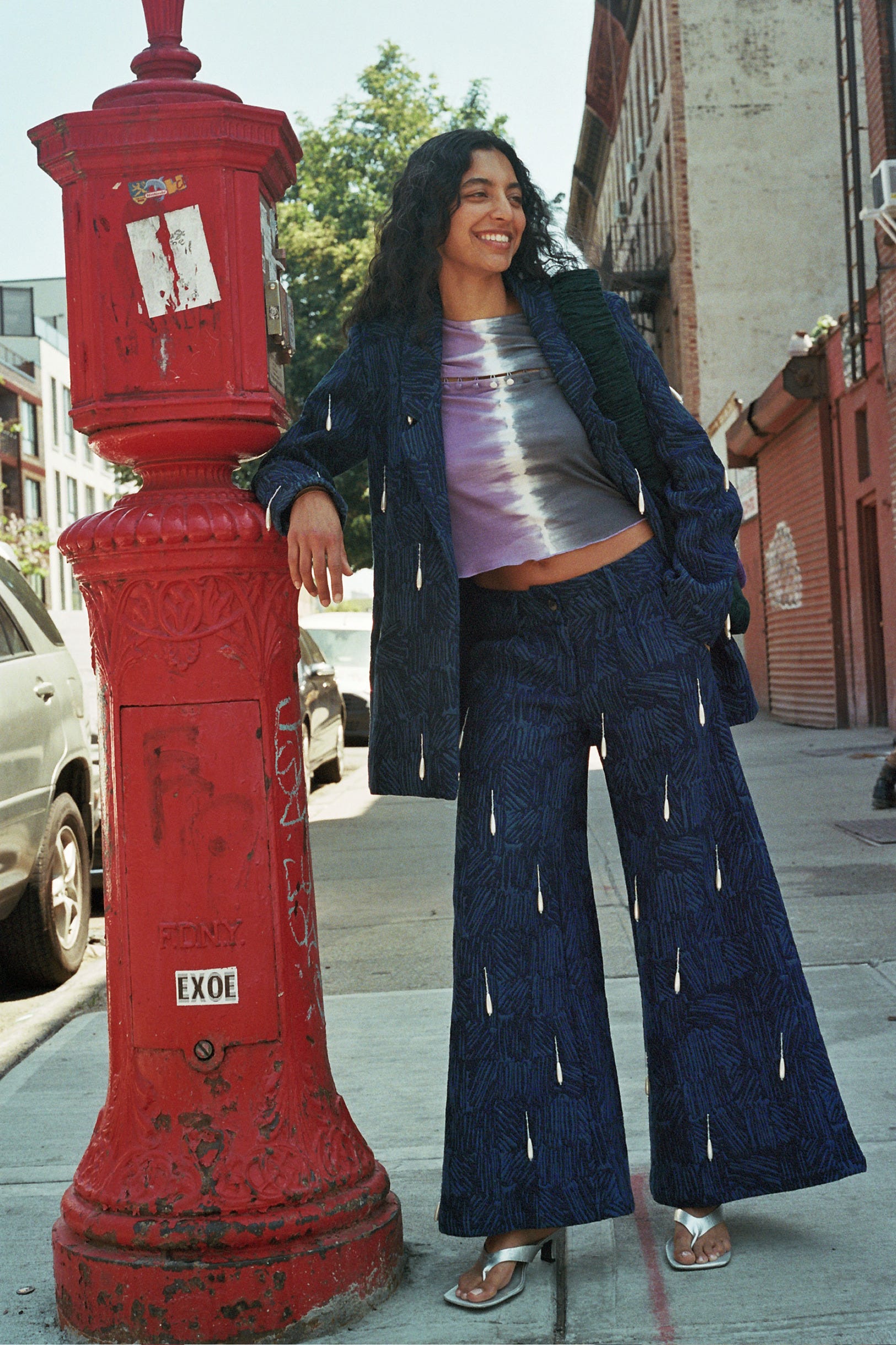
Featuring butterfly motifs, various shades of purple, a fusion of tradition and modernity, and an ancient tie-dye technique called bandhini, abacaxi’s pre-spring 2026 capsule collection is an amalgamation of designer Sheena Sood’s favorite things.
Following her fall-winter 2025 collection titled Apsara, Sood felt inspired to create a new collection that revolved around the bandhini pieces she had just debuted. Dating back to 4000 BC in South Asia, this intricate process makes a unique pattern by tying very small knots, dunking the fabric in natural dyes, and pulling apart the knots to reveal a design made up of tiny, contrasting circles. The word bandhini comes from the Sanskrit and Hindi word bandh which means to bind or to close. Traditionally, this technique is done on silk, which is how Sood created her periwinkle blue and deep brown sarongs for spring-summer 2025’s Mystic collection. This time however, the self proclaimed “textile nerd” known for her ability to combine her Indian heritage with western-leaning styles wanted to try this technique using a jersey cotton fabric.


Jersey, compared to silk, is a much more casual and versatile fabric due to its stretch and durability. Some of Sood’s most popular designs are made of jersey as it is a forgiving fabric that she says has the ability to “grow with you or shrink with you,” as your body changes. So while she was interested in seeing how bandhini would look on this new material, she also wanted to continue her brand’s legacy of creating clothes that are inclusive to a wide range of physiques.
While the process of tightly plucking and tying small sections of fabric is already quite laborious, doing so with a thick material like jersey posed a challenge for the artisans Sood works with in Bhuj, India. Such intricacy and experimentation took time that didn’t follow the brand’s typical semi-annual collection calendar, but still deserved to be showcased alongside complementary abacaxi designs. “This particular collection has a different process than my usual one, where it’s like a puzzle —piecing things together that I wanted to use and turning it into a cohesive collection,” says Sood, “This one is like a mix of my favorite things.”

The standout bandhini dyed shirt, dress, leggings and skirts feature a familiar motif for abacaxi - the butterfly. Sood loves butterflies. From her childhood bedroom wallpaper to Mariah Carey’s Butterfly album being the soundtrack of her high school years, they’re a mainstay for the designer and she sees them as a symbol of transformation. “I’ve always been told that if a butterfly lands on you, it’s good luck,” reflected Sood.
These bandhini butterfly pieces come in two neutral colorways, espresso and dark grey, while brighter accent colors create the butterfly motif and linework. Because the design features three distinct colors, each garment had to be tied, dyed, and dried three times — a time-intensive process. Every step of this process was done by hand, making each garment one of a kind.


Innovation, individuality, and community are at the core of everything Sood creates. While the obvious goal for any business owner is to earn a profit, Sood’s relationships with her manufacturers are vital to keeping these sacred artforms around for future generations. Adapting traditional techniques to create clothing that can be worn in a modern context provides work for craftspeople whose jobs are being taken over by machines through fast fashion industrialisation. While a lot of arduous work goes into creating each garment, Sood says her manufacturers will ask, “When are they going to get larger orders?” She goes on to say that, “Even though it’s individual women knitting and crocheting in their homes, they want to do more business.”
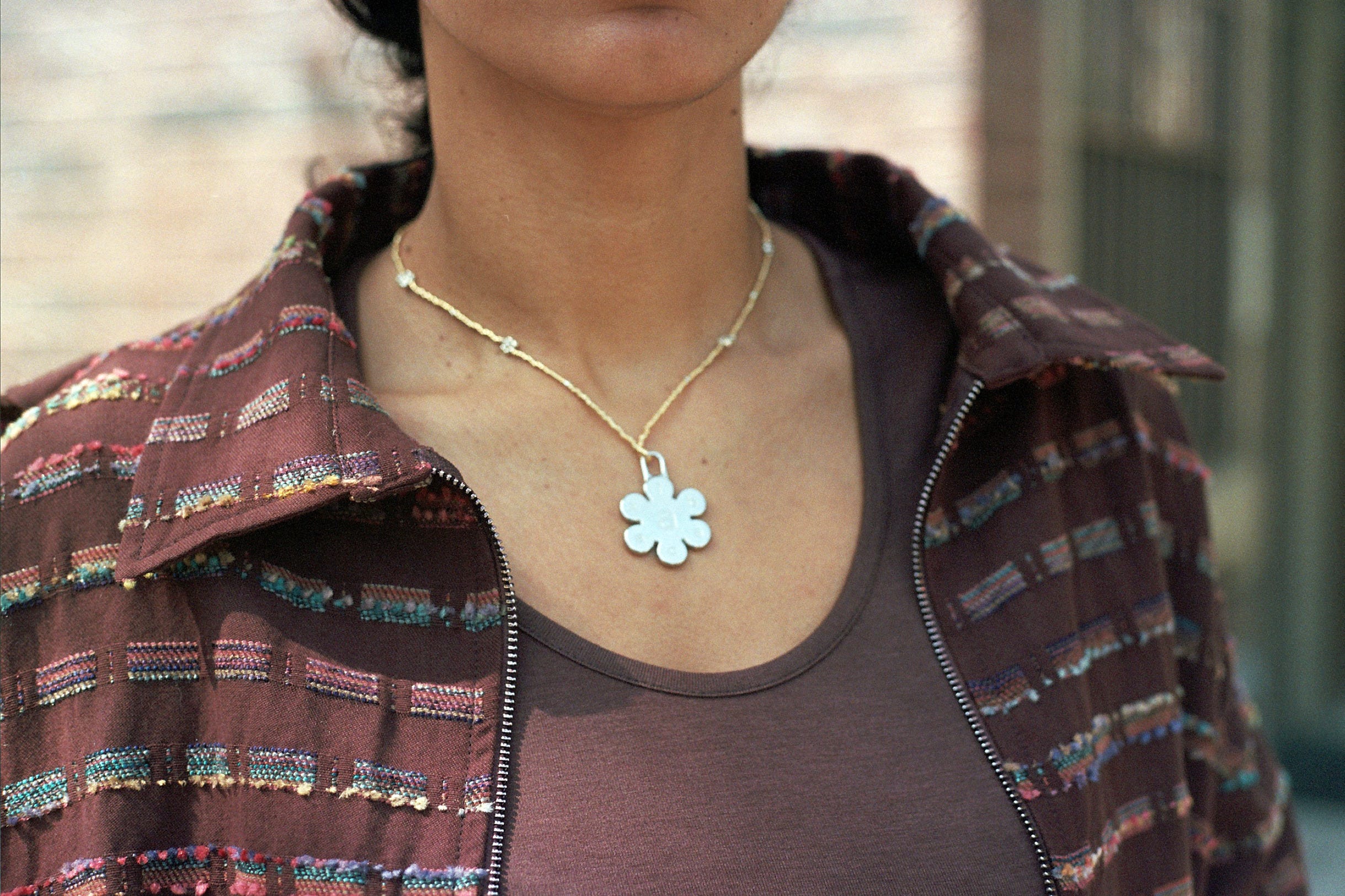
Bandhini is not the only fabric manipulation technique done by hand that Sood is proud to incorporate in her designs. In this collection, there is a quilted, indigo-dyed, jacquard suit set that’s hand embellished with hanging pearlescent beads, as well as a rainbow-striped jacquard jacket and skirt set with a detachable backpack that comes in cream and espresso. Both fabrics were created in Punjab, India. There is also a smocked skirt that can be worn as a dress, a silk chiffon top with fabric buttons that attach to a matching skirt to make a dress, and a sari-style blouse and matching scarf that use a resist dye technique known as clamp dying to create the pattern.
Textile design is Sood’s first love, and is the heart of abacaxi. “I really wanted to bring the traditional Indian textiles into that more contemporary wear in an authentic way, where it’s also about sharing the history behind the tradition. Because, of course, there’s so much garment production in India, there are so many brands who do all of their embroidery in India, but there’s not as much focus on the history behind those practices.”


Through her international travels, Sood has met and later collaborated with a number of artisans whose work she admires. All of her crochet and knit pieces are made in Peru, where they have a long-standing tradition of working with native cotton strains and alpaca wool (where the crochet butterfly purse styled in the lookbook with the bandhini butterfly dress was made). The woven crossbody bag was made by an artisan she met in Oaxaca, Mexico (styled with the cream jacquard skirt and jacket set). Even the brand’s name abacaxi is the Portuguese word for pineapple, where she first heard it sung by fruit sellers on the beaches of Morro de São Paulo, Brazil.
This collection encapsulates everything Sood has built with abacaxi over the last 12 years, as every garment and accessory in the lookbook is handmade in either India, Mexico, Peru or New York City. She photographed the thoughtfully stylised pre-spring collection throughout her neighborhood of Prospect Heights, Brooklyn, worn by her friend and first-time model Nazuk Kochhar, and shot with her father’s old film camera. Set in New York City, the photographs radiate the same warmth and ease Sood felt on the sand in Brazil, dreaming of creating textiles to one day use in a collection of her very own. They portray a young woman who confidently wears these designs while going about her day in a way that is both aspirational and practical, the way that Sood intended them to be worn. They embody innovation, creativity, and appreciation for the artisans who created these techniques thousands of years ago.

Beautiful!