

Rajiv Menon Contemporary, Los Angeles
Words by Shelanee Marcelline
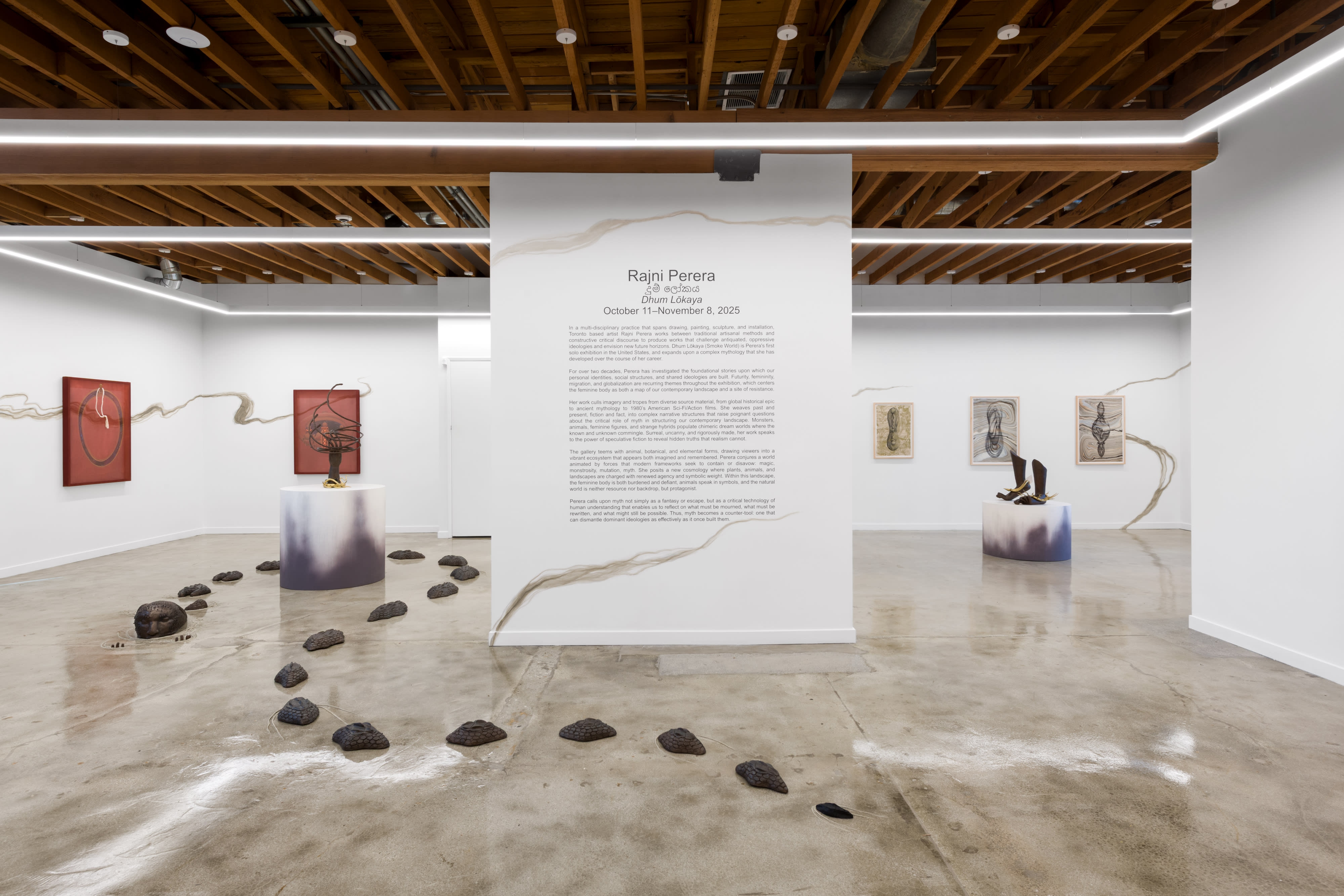
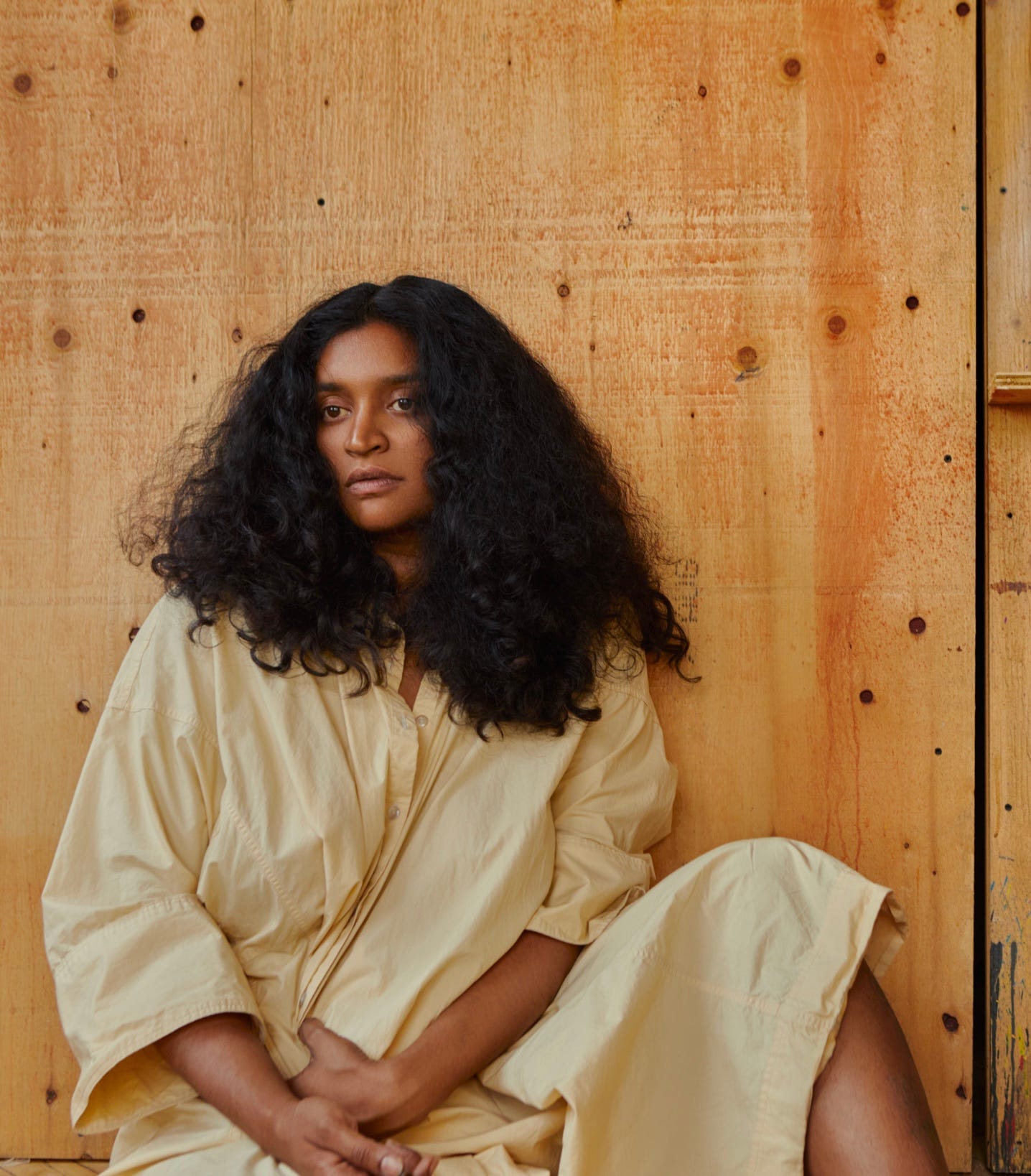
On a quiet Saturday morning, I drove across the city to Rajiv Menon Contemporary to see Dhum Lōkaya (Smoke World), a solo exhibition by Rajni Perera—an artist whose name I’d been hearing more and more in global art circles. Born in Dehiwela, Sri Lanka, and now based in Toronto, Perera has shown across the world, from the PHI Foundation in Montreal to the Museum of Contemporary Art in Lyon, and even the UAE’s Sharjah Biennial. This marks her first solo exhibition in the United States—a milestone that feels especially significant for those of us in the diaspora, seeing her work arrive in Los Angeles, a city built on migration and reinvention.
Upon entering the gallery, Bittergourd (2025) stood waiting—a terracotta sculpture of a woman’s body, her arms cupping two bowls that burned incense continuously through the day. The smoke traveled through the hollow of her form, winding upward before escaping through the carved crown of her head, filling the entryway in a slow, steady exhale. I stood still for a while, watching, breathing in the familiar scent of frankincense.
In Sri Lankan culture, bittergourd—a knobby green vegetable long revered in Ayurvedic cooking—is as medicinal as it is symbolic. Its fried form, known in Sri Lankan culture as karela, is a crisp, savory topping for rice and curry—the kind of side dish I snack on before dinner even begins. In its raw, more potent state, it’s steeped into tonics and remedies meant to cool the body and cleanse the blood. Seeing it reborn here as a woman’s body felt deeply familiar. I thought of my own mother—how, after immigrating to Los Angeles, she’d return home from long graveyard shifts at a diner, still managing to have food waiting, the kitchen air always heavy with spice and steam. The sculpture felt like her: a figure of nourishment and endurance, shaped by heat and labor, offering what she could to keep the world turning.
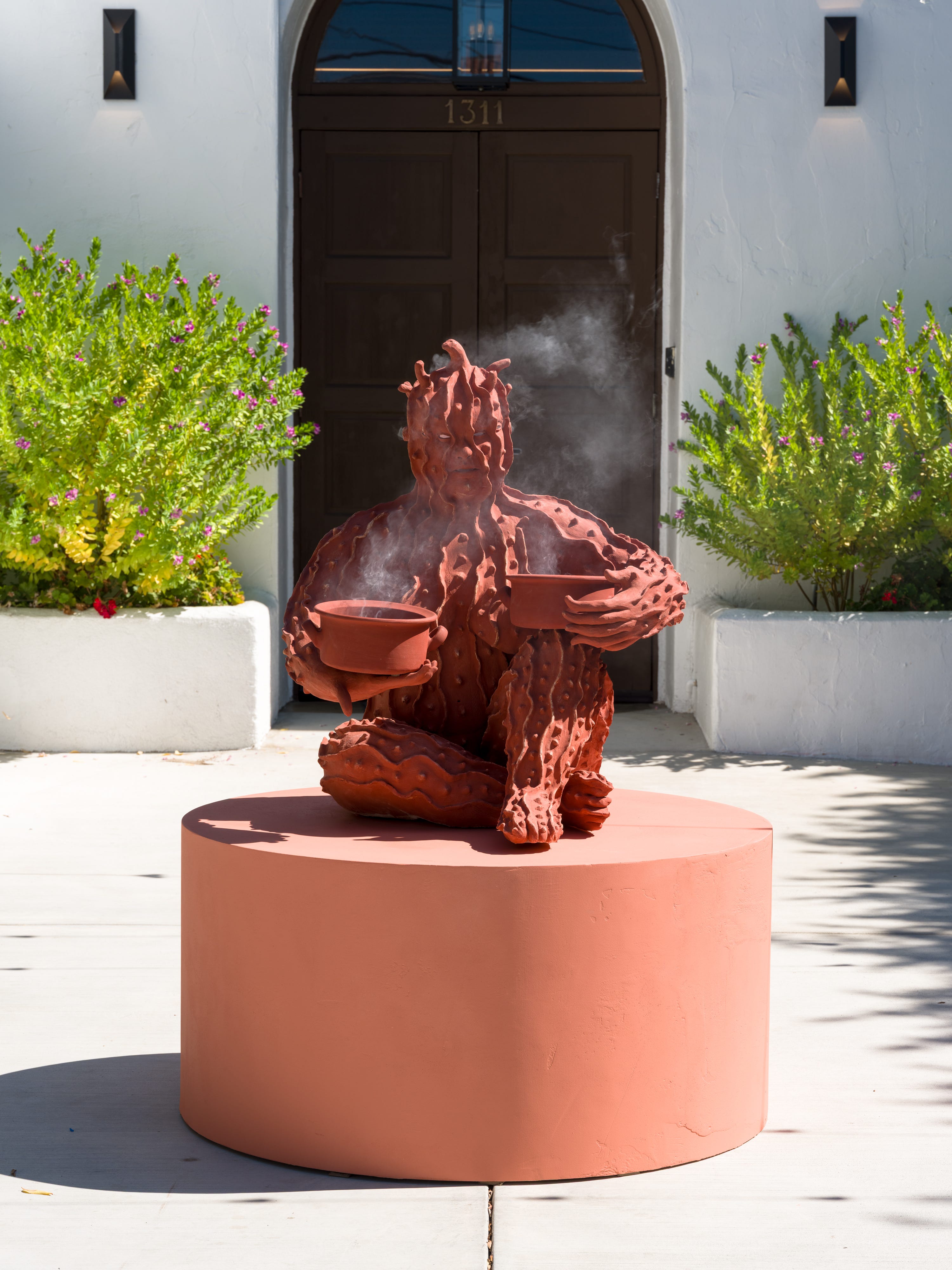
But Bittergourd also reminded me how much this story expands beyond her—how it belongs to migrant women everywhere, especially here in Los Angeles. The women who hold this city together behind the scenes; who keep families fed, traditions alive, and neighborhoods breathing while their own fires are rarely acknowledged. They are the quiet infrastructure of migration itself—the emotional and physical fuel source of survival. Perera’s sculpture gave that truth a body. It made visible the unseen labor that has built not only our families but the city itself.
At the beginning of this year, before the exhibition opened, wildfires tore through my hometown in Altadena. I had just touched down at LAX after visiting family in Sri Lanka that same afternoon the fire swept the city. By dawn, the streets I’d grown up on were unrecognizable—charred, skeletal, unmade. Somehow, our house survived. I still remember standing on the curb, breathing air that felt too thick to be real, watching smoke drift through the same sky I’d spent my childhood under. I’d be lying if I said the smell of it hasn’t followed me since—through my hair, my clothes, my memories, my dreams. Because maybe that’s the thing about fire and smoke—they don’t just destroy; they reveal what’s meant to endure.
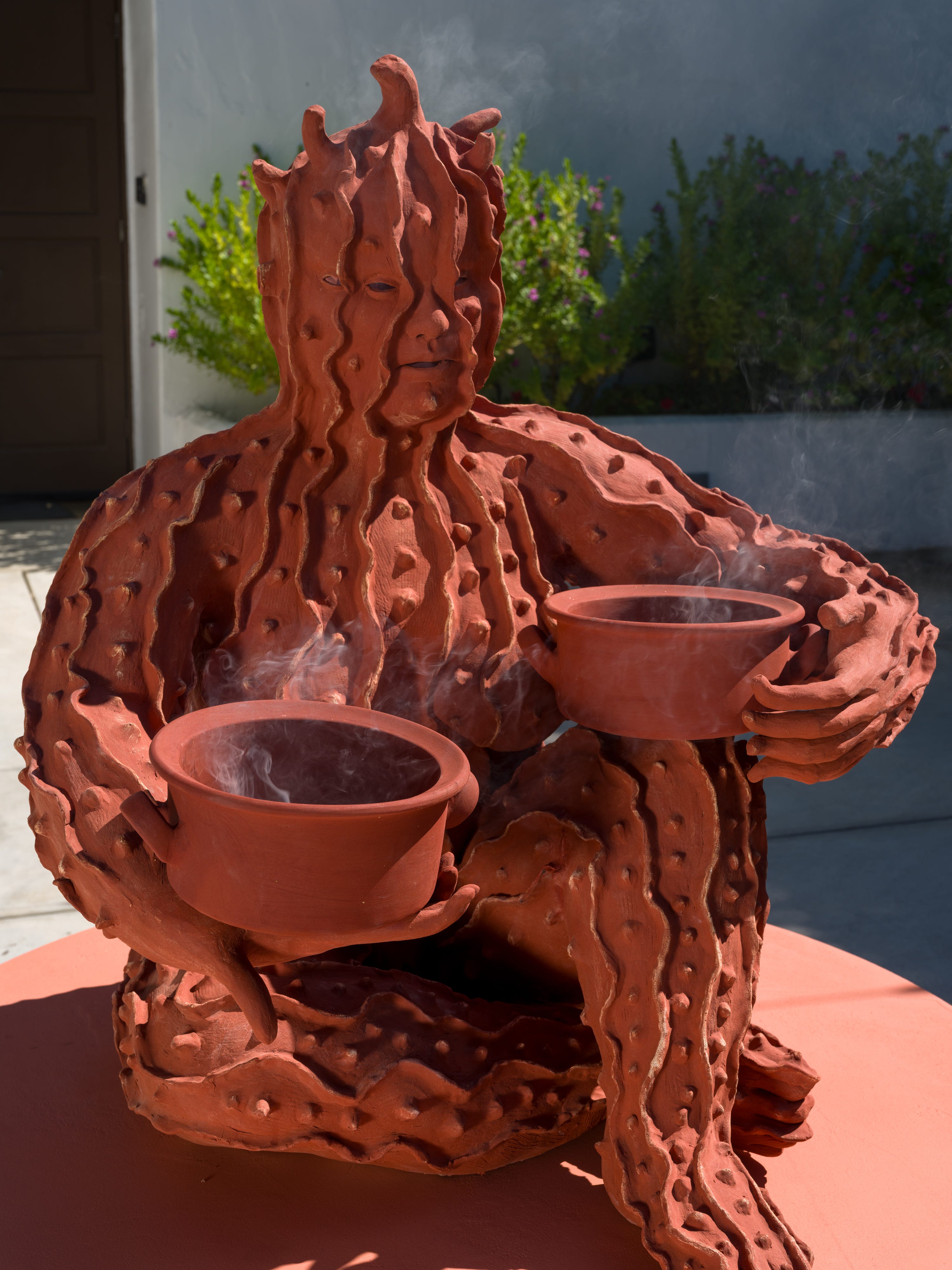
So when I stood before Bittergourd, watching the incense burn through its crown, I thought about what Perera said that night at the opening: “In Sri Lanka, something is always burning.” Whether it’s the trash on the street, the food in our kitchens, or the incense at our temples—there is always smoke, always transformation in motion. Her words made me tear up, yet they also brought me back to that morning after the fires, to the surreal quiet that follows disaster. To how, even when everything seems lost, something inside insists on surviving.
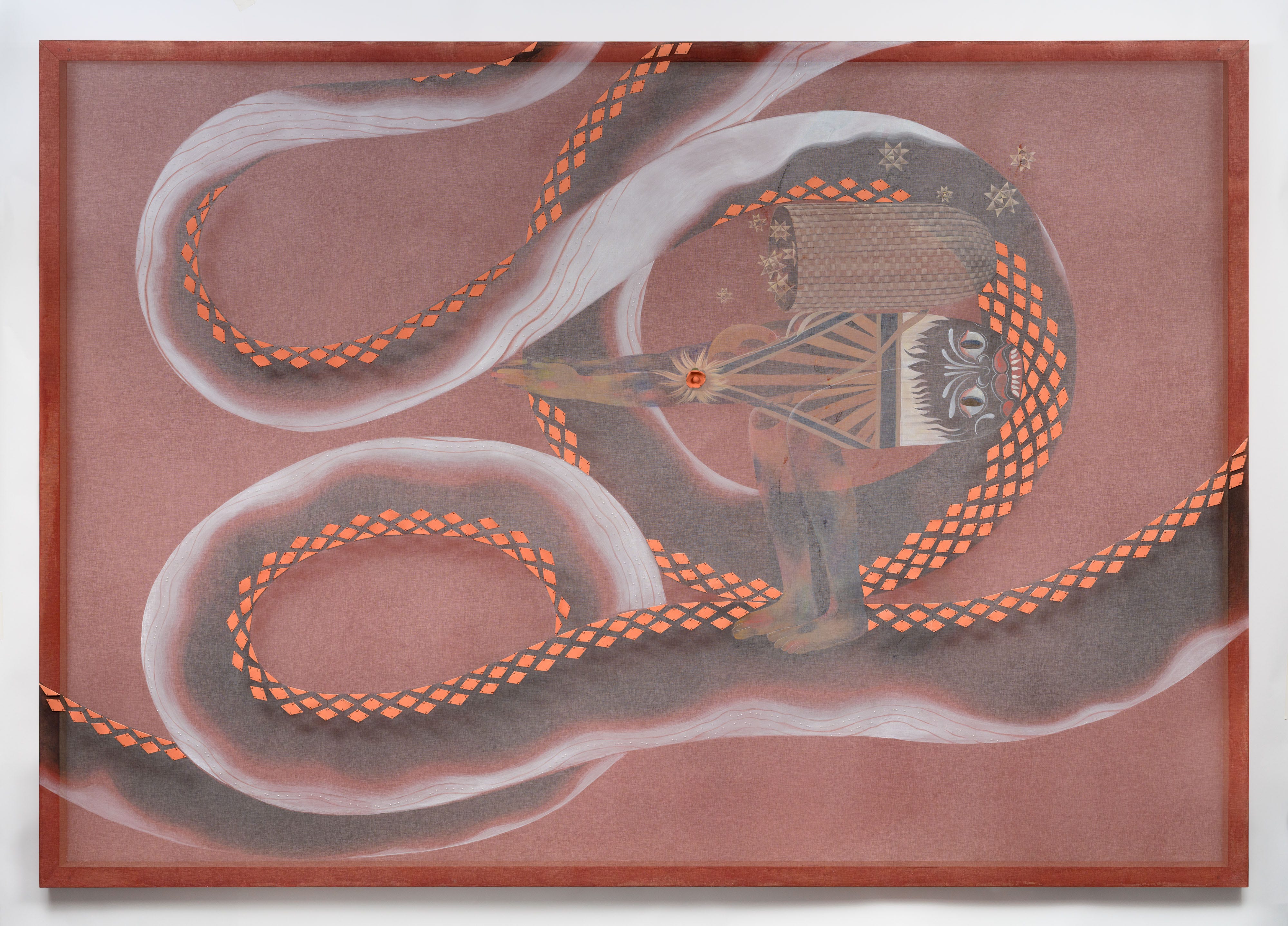
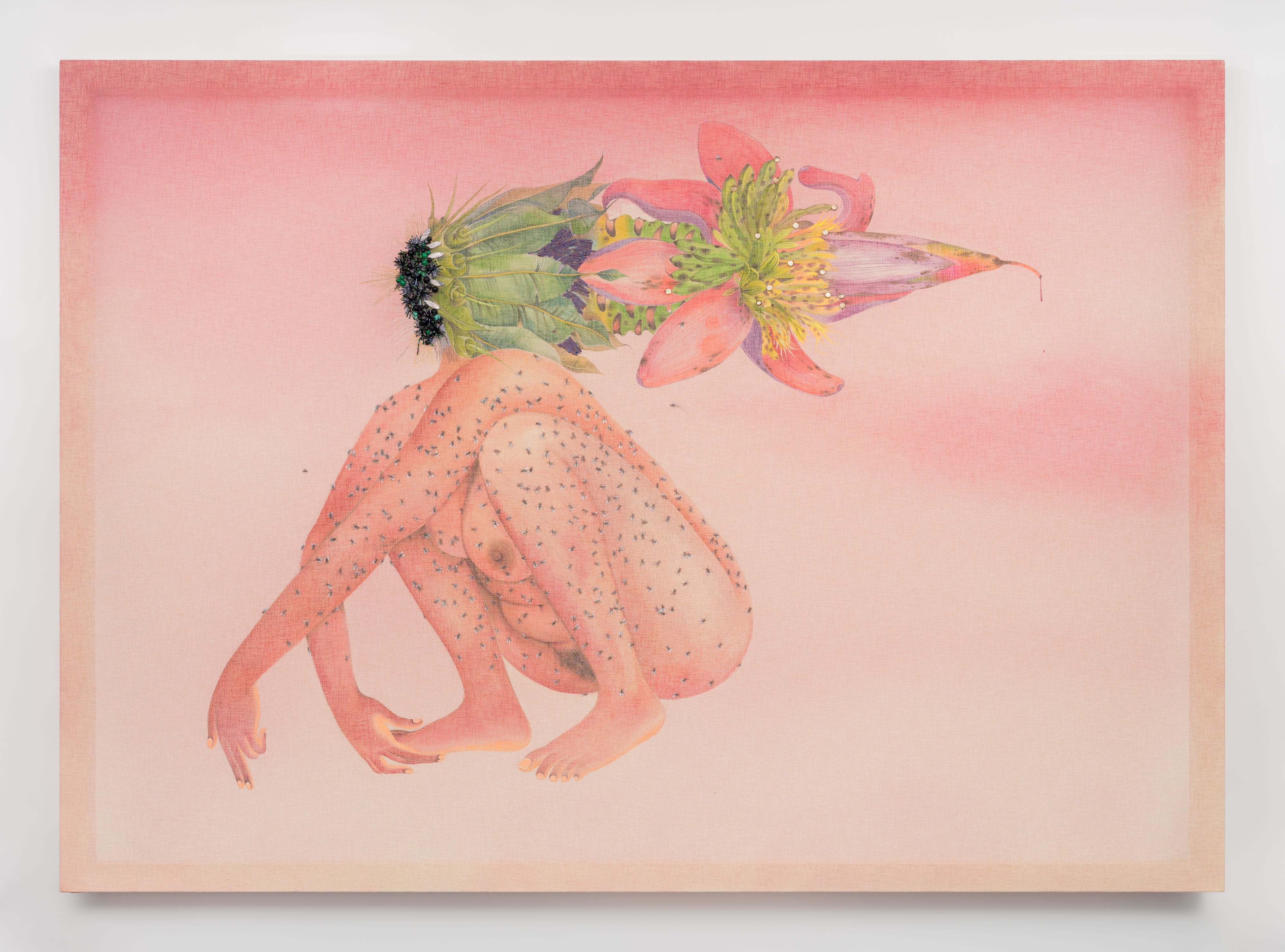
The gallery around me pulsed with this same quiet resilience. In Dark Matter (2025) and Primitive (2025), Perera threads the fantastical with the familiar, stitching together the cosmos and the human condition. Dark Matter ripples with serpentine forms—snakes that weave through constellations of glass pearls, connecting worlds as though they’ve always been one continuous body. Primitive centers a single woman crowned with a blooming flower, covered by flies, her form suspended somewhere between deity and dream.
Together, they read like pages from a living myth—fantasy not as escape, but as a mirror. Through these works, Perera grounds her speculative visions in the organic textures of life on Earth. There’s an uncanny intimacy to it all; even her most intergalactic imagery feels tethered to something we recognize. The serpents, the blossoms, the pulse of color—they belong as much to the universe as to the soil beneath our feet.
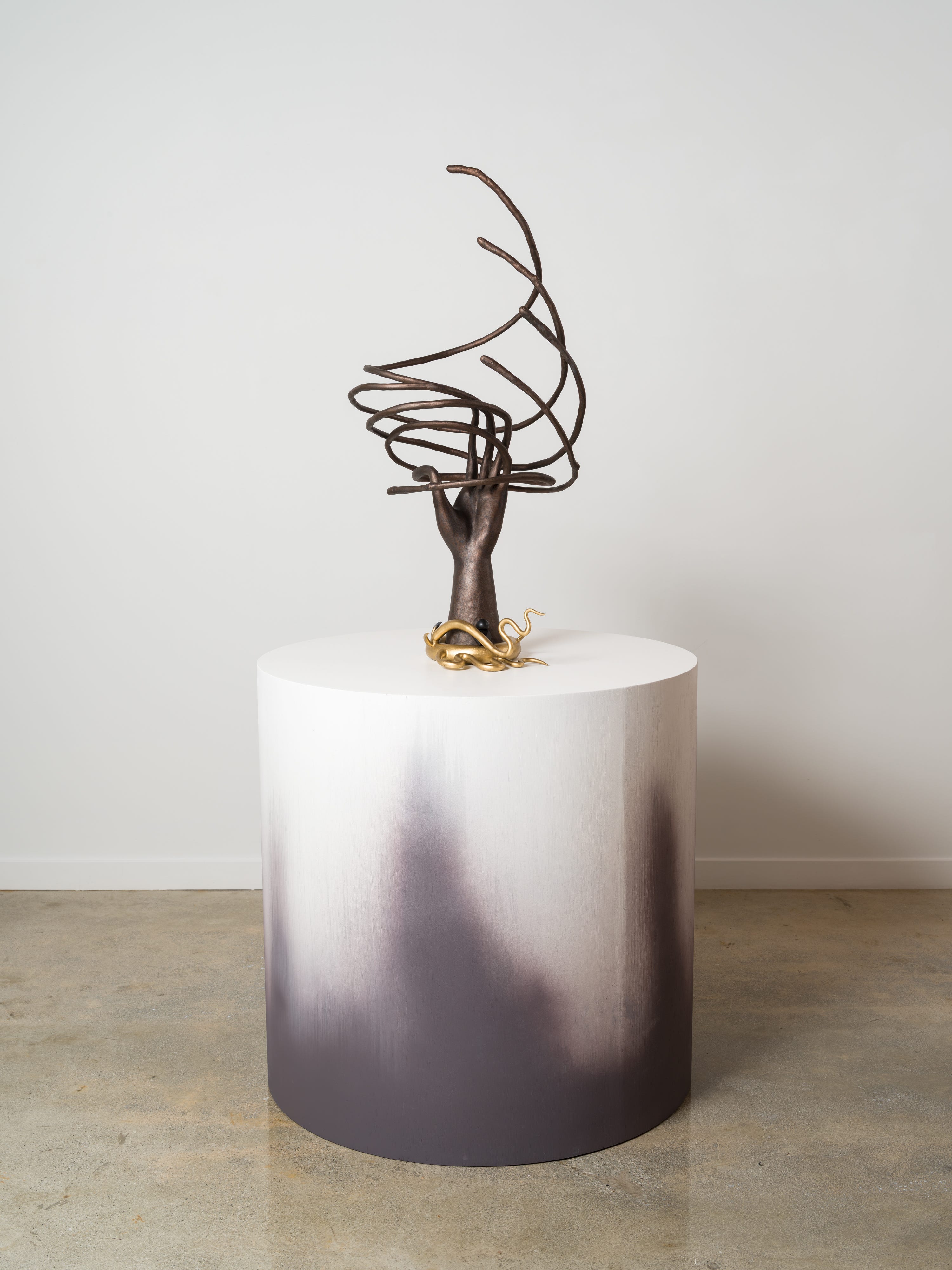
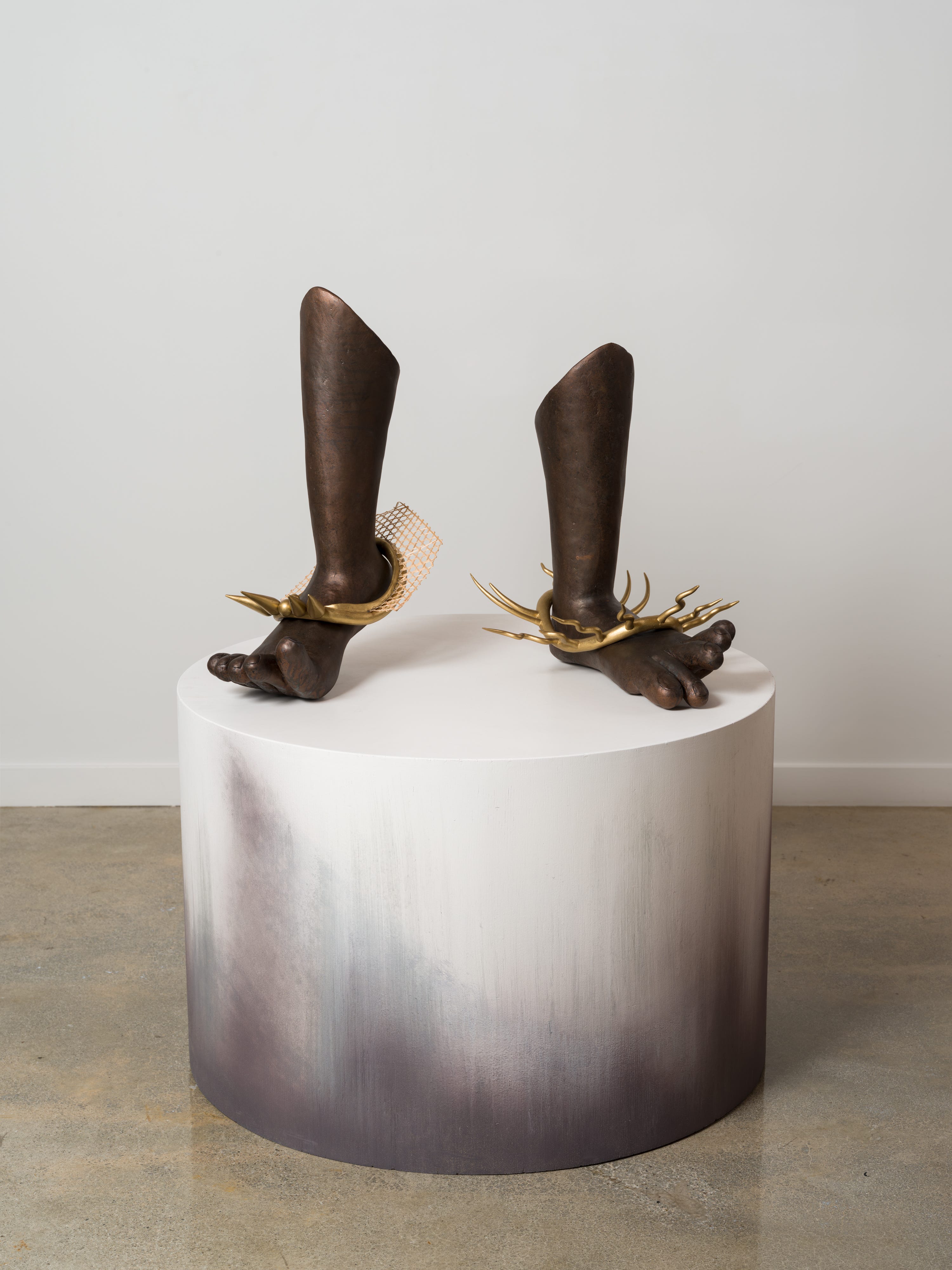
Then there are the sculptures Bangle (2025) and Dance Dance Revolution (2025), which reimagine the adornments of South Asian womanhood—our bangles, our anklets, our jhumkas—as artifacts of resistance. Bangle rests heavy with patinated bronze and wax, its surface cracked like sunburned earth. Dance Dance Revolution transforms the steel anklets of Sri Lanka’s Kandyan dancers into something both familiar and subversive: jewelry that gleams, but also guards.
As Perera explained, women’s adornments in South Asian culture once doubled as armor—our bangles, our anklets, our jhumkas —talismans of protection, their sound meant to announce strength as much as grace. Over centuries, they softened. Simplified. Made easier to overlook. I couldn’t stop thinking about that—how something as small as an ornament could once signify rebellion, and how time has a way of sanding down even the sharpest symbols.
That duality—the smoke and the spark—is what makes this show feel so alive. It’s not nostalgia, but invocation. Perera reclaims myth as a tool of critique, dismantling colonial and patriarchal frameworks while reimagining new cosmologies in their place. She builds a world where mutation is freedom, where multiplicity is survival, where the feminine body is a site of both resistance and rebirth.
Standing there, my mind wandered to my parents—to how they left Sri Lanka, moving away from a civil war only to build a life in a country that didn’t always know what to make of us. As a child, I’d beg my mother not to pack kottu roti or parippu (dhal curry) for lunch, plead with her not to wear a sari to school events. Being Sri Lankan felt like an invitation to be othered. Yet here I was, decades later, in a Los Angeles gallery surrounded by brown faces and shared nostalgia, watching a Sri Lankan woman’s mythology claim space on gallery walls in Hollywood.
I could sense stories like ours all around—quiet, steady ripples across this city. Migrant women who, in their own ways, carry fire every day. Los Angeles runs on their endurance, even as that sense of belonging feels increasingly fragile, threatened by a political administration that treats identity as an inconvenience. Dhum Lōkaya became, in that moment, an intentional act of remembrance for them too.
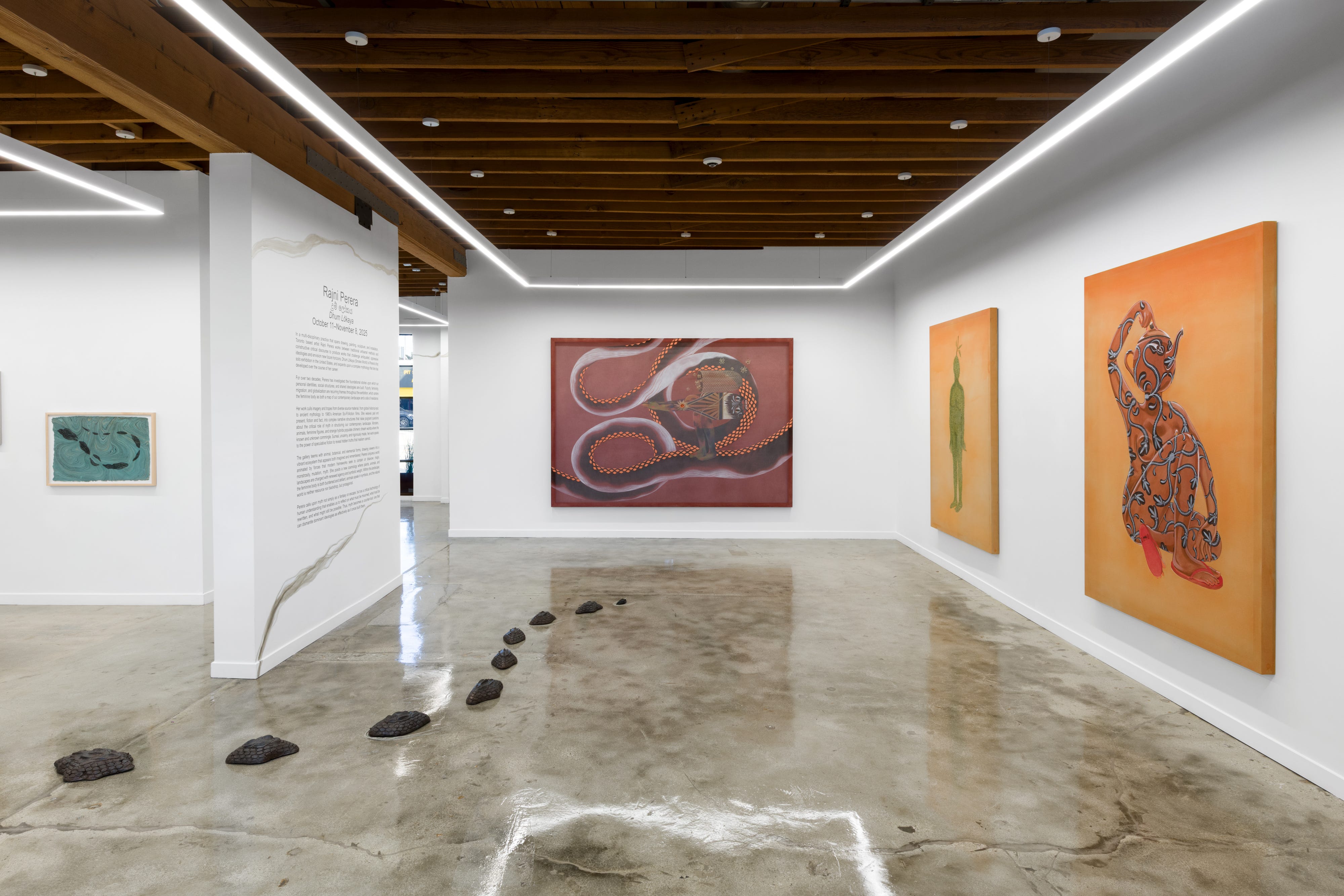
Moving through the gallery, my thoughts returned to Sri Lanka itself—a country whose spiritual life runs as deep as its fault lines. Predominantly Buddhist, but woven with Hinduism, Islam, and Christianity. A place that has endured colonization, civil war, genocide, economic collapse, tsunamis, and still, somehow, finds its way to faith each morning. The island, like Perera’s vision, has always been a Smoke World—a place where history burns but faith endures, where belief is both a scar and a lifeline.
As I left the gallery, the scent of the incense smoke left with me—the same kind my grandmother would burn each morning in her Kadawatha home, the same scent that lingers after the fires here in LA. Maybe that’s what Dhum Lōkaya is asking us to remember: that smoke, like memory, never really dissipates. It drifts, it carries, it transforms—but it always returns to you.